


Department of Energy certified case studies just validated over $200Bn in annual energy value by Unlocking recycled energy losses equal to half of the USA’s total power consumption… Industry veterans are expecting Tesla level disruption in less than 18 months.
The IEEE (the Institute of Electrical and Electronics Engineers, the organization that literally writes the standards your phone, computer, and the entire global electrical grid operate on) has officially published our paper in their UPEC 2025 conference proceedings. You can find it yourself at IEEE Xplore.
Let me put that in perspective. Getting published in IEEE isn’t like getting a gold star on your homework. This is the Super Bowl of electrical engineering validation. When IEEE publishes your work, it means your methodology has been scrutinized by experts, your data has been verified, and your claims (no matter how audacious) hold water.
And our claims? They’re pretty audacious. Except it actually works.
The Problem Everyone Knew About (But Couldn’t Solve)
EMFs aren’t just in your home. They’re in your office. Your factory floor. Your data center. Your airport. Every building you’ve ever walked into is swimming in electromagnetic interference and we’ve been ignoring it like secondhand smoke in the 1970s.
Turns out, machines hate it too. EMFs cause overheating. Accelerate breakdowns. Shorten equipment lifespans. The result? A global maintenance and servicing market screaming toward $1.1 trillion by 2030. Billions of dollars spent fixing damage from a problem nobody bothered to solve.
Until we did.
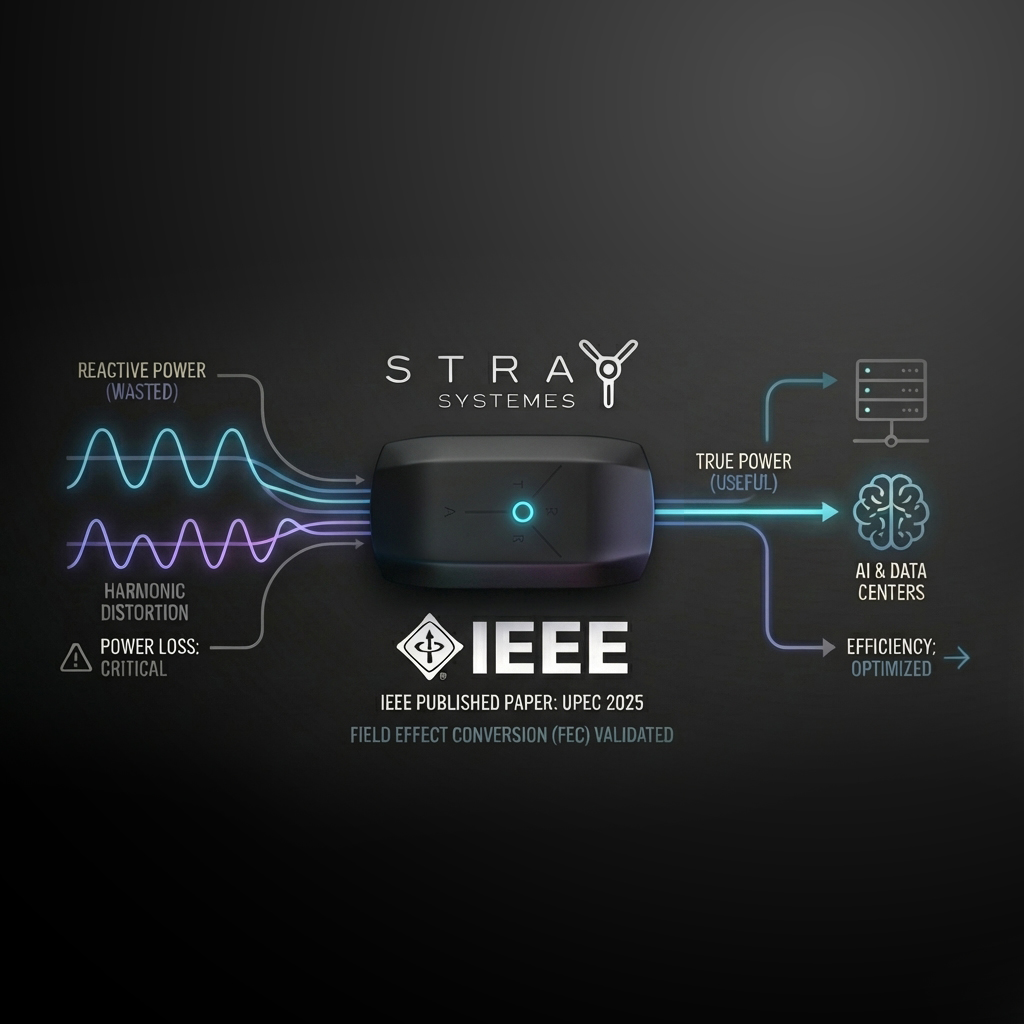
STRAY SYSTEMES figured out how to take electromagnetic waste, the EMI, the bad harmonics, the invisible noise destroying your equipment from the inside out, and convert it into clean, usable power. Not filtered. Not suppressed. Converted. Waste watts into work watts. Plug-and-play.
This isn’t theory. We’ve run 20+ pilot studies across Department of Defense facilities, data centers, and manufacturers in the U.S., EU, and MENA. Every single one validated the same thing: the Stray AmpMiner Zero™ doesn’t just recover lost energy. It cleans the electromagnetic environment for everything and everyone in the building.
Less noise. Less stress on equipment. Less stress on people. More power. More performance. More life out of every machine on the floor.
One passive device. No downtime to install. No moving parts to fail. And it pays for itself by turning the energy you’re already losing into the energy you’re currently paying for twice.
That’s not innovation. That’s a reckoning.
When your data center runs those blade servers 24/7, when Bitcoin miners grind through cryptographic puzzles, when AI systems train on petabytes of data, all of those operations generate something called reactive power. Think of it as the electrical equivalent of a musician playing slightly out of sync with the rest of the orchestra. The notes are technically there, the instrument is making sound, but the result is noise rather than music. Your equipment has to work harder to extract the useful signal from the chaos.
The numbers are sobering. The International Energy Agency projects that data center electricity consumption in the United States alone will double by 2026. AI-driven facilities require ten times more power than traditional computing. We’re talking about a 166% load increase by 2030 in the worst-case scenario. And here’s the kicker: upgrading the grid to handle all this is estimated to cost over $2.5 trillion by 2035.
Traditional solutions? They’re band-aids on a bullet wound. Passive harmonic filters are cheap but dumb; they can’t adapt to changing loads. Active filters are smart but expensive, complicated, and require downtime to install. Neither actually converts the wasted power back into something useful. They just manage it. Attenuate it. Accept the loss.
Until now.
What We Actually Did (The Part That Made IEEE Take Notice)
Our paper, titled “Novel Principle of Reactive to True Power Conversion for AI, Data Centers, and BTC Mining,” introduces something we call Field Effect Conversion (FEC). And before your eyes glaze over at another acronym, let me explain why this one matters.
Every other solution in the market treats electricity’s electrical properties: voltage, current, and power factor. We decided to treat the magnetic properties instead. It’s a paradigm shift so fundamental that it’s like discovering you’ve been trying to tune a radio by adjusting the volume knob when the breakthrough comes by changing the geometry of the antenna. Similar device, completely different approach, dramatically better results.
No complicated control schemes. No downtime for installation. No expensive active components that can fail. We’re talking about a passive-parallel device that functions like a magnetic buffer, intercepting harmonic noise and converting it back to the fundamental 60Hz frequency that your equipment actually needs.
Here’s the process, extracted directly from our patent documentation:
- A quasi-common-mode array passively engages odd harmonic field activity at the return path
- Captured harmonics get routed into a custom-engineered waveguide for cancellation and reshaping
- The distorted magnetic field transforms into a phase-corrected fundamental waveform
- Real-time magnetic field redistribution corrects phase rotation upstream while improving every known power quality parameter downstream
If that sounds like science fiction, I get it. But the case studies don’t lie.
The Numbers That Made Skeptics Into Believers
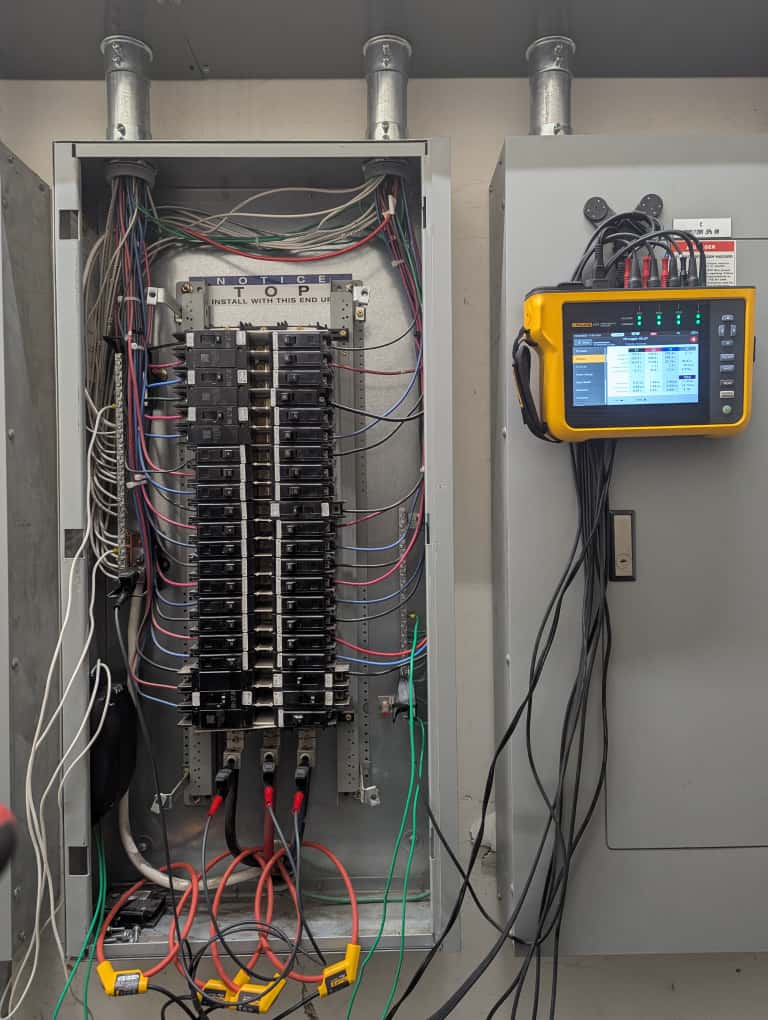
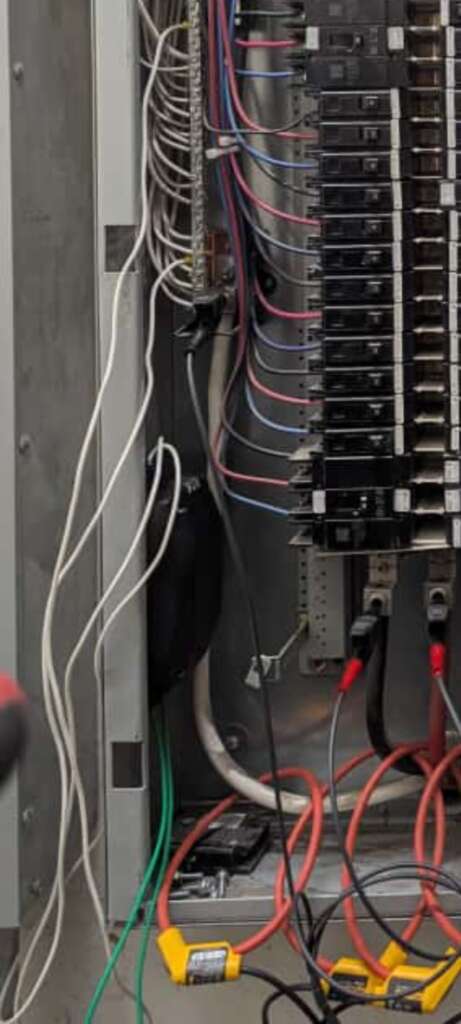
At MULTACOM, a 0.5MW data center in downtown Los Angeles, we connected our device to a single 400A subpanel powering 50 blade servers. The results, measured by a Fluke 1777 Class A power quality analyzer (the gold standard in the industry):
- Apparent power reduction: 25.64%
- Neutral voltage leakage: Down 48.39%
- Neutral current leakage: Down 27.01%
- Total harmonic current: Down 41.53%
- Upstream transformer consumption: Down ~19.1%
But here’s where it gets really interesting. Those electrical improvements cascaded into computational improvements:
- CPU speed and stability: Up 1.5% to 3.5%
- Instruction throughput: Up 0.5% to 1.5%
- Memory bandwidth: Up 2% to 5%
- DRAM latency: Improved by 1 to 3 nanoseconds
- Network throughput: Up 1.5% to 4%
That translates to a 6% improvement in FLOPs-per-watt. In the world of AI and high-performance computing, that’s not marginal. That’s transformational.
In Bitcoin mining facilities in Texas, we saw similar patterns. Power factor improvements of nearly 10%. Operational energy efficiency increases of approximately 11%, meaning operators could power one additional miner for every nine already connected, at no additional upstream cost. At a 700MW facility, an isolated pool of 484 miners saw hash rate climb from 89.47 PH/s to 92.257 PH/s, with a 7.28% improvement in energy efficiency (J/TH).
Why This Matters Beyond Our Bottom Line
Let me be real with you: this isn’t just about selling more units (though we certainly won’t complain about that). This is about solving a problem that threatens to strangle the AI revolution before it reaches its potential.
Every conversation about AI capability eventually hits the same wall: power. Where’s it going to come from? How are we going to afford it? What about the carbon footprint? These aren’t abstract concerns. They’re existential threats to an industry projected to reshape human civilization.
Our technology, at scale, contributes an estimated 20 GW of increased capacity for U.S. commercial and industrial activity. That’s approximately 70 million metric tons of CO₂ avoidance annually. At a fraction of the cost of traditional grid upgrades.
The IEEE publication validates that these aren’t marketing claims. They’re engineering reality.

What Comes Next
The UPEC 2025 conference at Brunel University London brought together delegates from 33 countries, all focused on one theme: “Crossing Energy Boundaries: Multi-Vector Solutions for a Carbon-Neutral Transition.” Our paper fit that theme like a key in a lock.
But publication is just the beginning. We’ve now got academic endorsement from Brunel University. Independent measurement and verification from Abraxas, a DOE-certified firm. Over 18 studies validated across approximately 750 GW of mission-critical facilities. UL 1283 and CSA C22.2 certification for commercial deployment.
The technology is real. The validation is complete. The path forward is clear.
For decades, reactive power has been treated as an acceptable loss, the cost of doing business in an increasingly electrified world. We’ve proven, in peer-reviewed fashion, that it doesn’t have to be.
That sci-fi engineer rerouting power from the deflector array to boost the engines? Turns out they weren’t writing fiction. They were writing prophecy.
We just made it real.
Claudio Giordano is a technology journalist and writer for StrayEffect, the communications arm of Stray Corporation. For technical inquiries or partnership discussions, contact [email protected].
The full IEEE paper is available at: https://ieeexplore.ieee.org/document/11279863